Katherine Johnson
1918 – 2020
United States
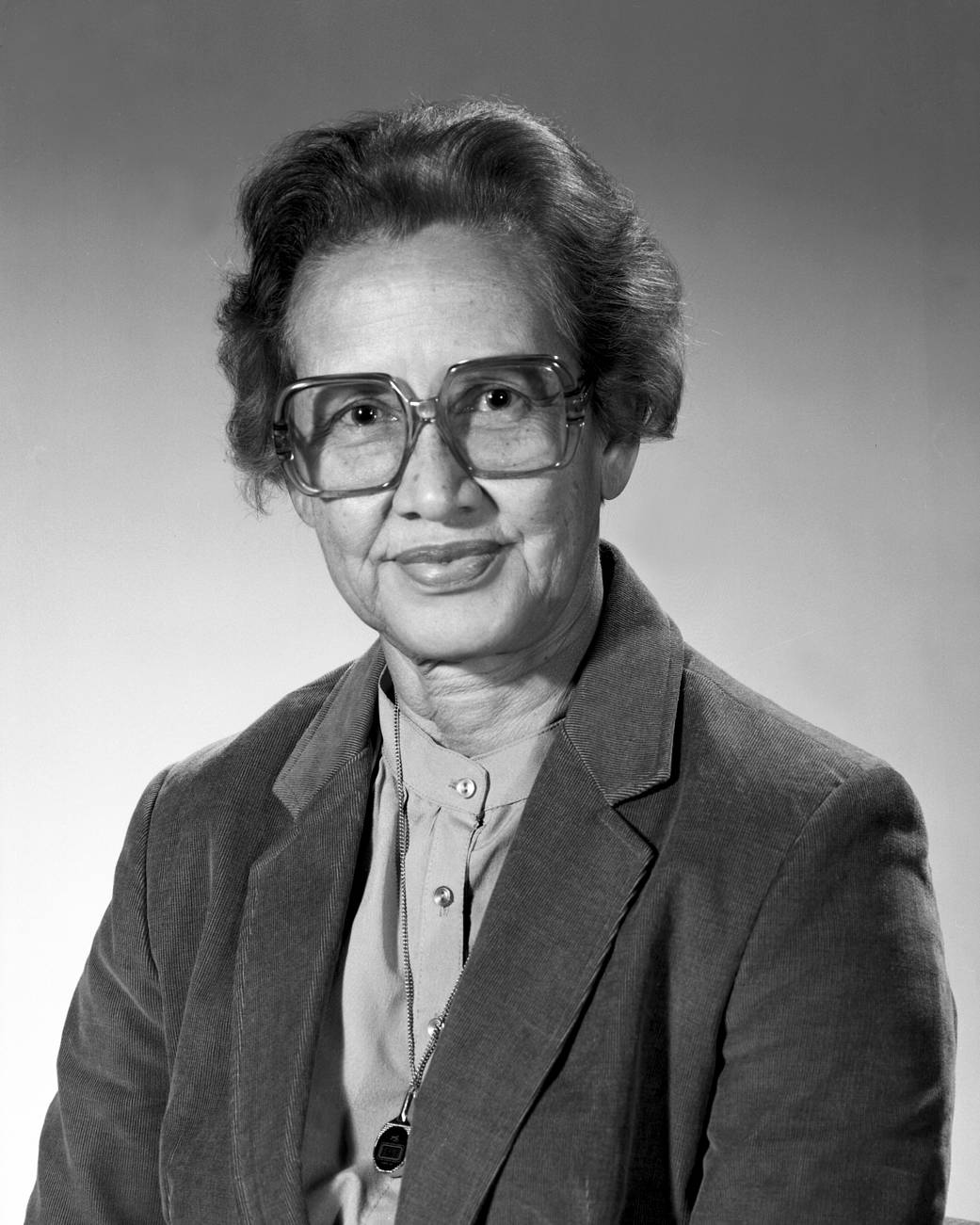
Mathematician at NACA and NASA's Langley Research Center whose trajectory calculations supported the first American human spaceflights, including John Glenn's 1962 orbital mission. She received the Presidential Medal of Freedom in 2015.
Early life and education
Katherine Johnson was born on August 26, 1918, in White Sulphur Springs, West Virginia. She skipped several grades. By 13 she was at the high school on the campus of West Virginia State College, and she entered the college itself at 18. There she was mentored by mathematics professor W. W. Schieffelin Claytor.
She graduated in 1937 with highest honors and a degree in mathematics and French, then taught at a Black public school in Virginia. In 1939 she was one of three Black students chosen to integrate the graduate program at West Virginia University. She left after the first session to start a family.
Langley
In 1952, while visiting relatives in Newport News, Virginia, she learned that the National Advisory Committee for Aeronautics (NACA) was hiring Black women as mathematicians. NACA hired her in June 1953. She joined the all-Black West Area Computing section, led by Dorothy Vaughan, and was soon assigned to the Maneuver Loads Branch of the Flight Research Division. For about four years she analyzed flight-test data, including an investigation into a plane crash caused by wake turbulence.
The space program
In the late 1950s her work turned to space. She contributed mathematics to Notes on Space Technology in 1957–1958. In 1960 she and engineer Ted Skopinski co-wrote a report on the equations for landing a spacecraft at a chosen point on Earth. According to NASA, it was the first report from the Flight Research Division to credit a woman as an author.
In May 1961 she did the trajectory analysis for Alan Shepard's Freedom 7, the first American human spaceflight. For John Glenn's orbital flight on Friendship 7 in 1962, the orbital calculations were done by computer, and Glenn asked that Johnson verify them by hand before he would fly. She later worked on calculations for joining the Apollo Lunar Module with the Command and Service Module, and on the Space Shuttle and the Earth Resources Technology Satellite (later Landsat).
Over her career she wrote or co-wrote 26 research reports. She retired in 1986 after 33 years at Langley.
Honors and legacy
In 2015, at age 97, President Barack Obama awarded her the Presidential Medal of Freedom, the nation's highest civilian honor. In 2016 NASA named a building at Langley the Katherine G. Johnson Computational Research Facility. Her other honors include NASA's Lunar Orbiter Award and three NASA Special Achievement Awards.
Her story reached a wide audience through Margot Lee Shetterly's book Hidden Figures and its film adaptation, in which Taraji P. Henson played Johnson. She died on February 24, 2020, at age 101.
Achievements
- 1937: B.S. in mathematics and French, with highest honors, West Virginia State College
- 1939: One of three Black students selected to integrate West Virginia University's graduate program
- 1953: Joins NACA's West Area Computing section at Langley
- 1961: Trajectory analysis for Alan Shepard's Freedom 7, the first American human spaceflight
- 1962: Checks by hand the orbital calculations for John Glenn's Friendship 7 flight
- 2015: Presidential Medal of Freedom
Sources
Suggest a correction: opens once the database is connected.