Thutmose III
c. 1479 – 1425 BCE (reign, including the years Hatshepsut ruled with him)
Egypt; campaigns in the Levant, Syria and Nubia
18th Dynasty king of Egypt who, after Hatshepsut's death, led many campaigns into the Levant beginning with the Battle of Megiddo, carried Egypt's power to the Euphrates and deep into Nubia, and built extensively at Karnak.
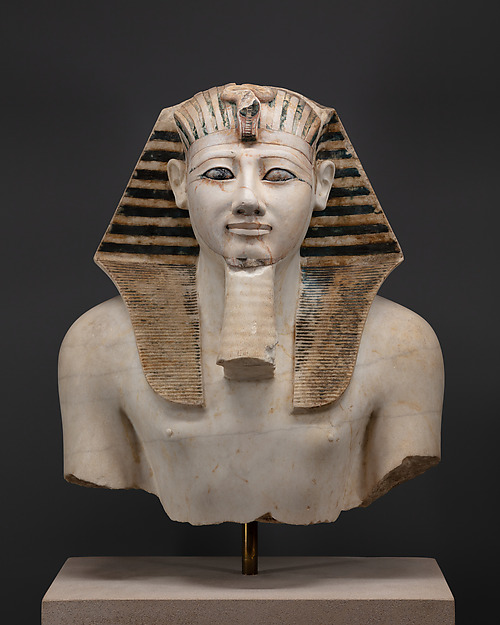
Early life and Hatshepsut
Thutmose III was the son of King Thutmose II and a secondary wife named Iset. He was still a small child, about three years old by one estimate, when his father died around 1479 BCE. His father's principal wife, Hatshepsut, became regent and then took the full titles of pharaoh, ruling for about two decades. Dates for Thutmose's reign are therefore usually counted from 1479 BCE, though he ruled alone only after Hatshepsut died around 1458 BCE. Before the end of her reign he had already been given command of the army.
Megiddo
When Hatshepsut died, a coalition of Canaanite and Syrian city-states led by Kadesh and Megiddo rose against Egyptian control. In his year 23, around 1457 BCE, Thutmose marched north. The Egyptian account, carved in the Temple of Amun at Karnak and based on records kept by the military scribe Tjaneni, describes his officers urging him to avoid a narrow mountain pass. The king insisted on taking it himself at the head of the army. The Egyptians routed the coalition outside Megiddo, but soldiers stopped to plunder, giving the enemy time to reach the city, which then had to be besieged. The account lists hundreds of prisoners, more than 2,000 horses, 924 chariots and great quantities of livestock. World History Encyclopedia notes it is the first battle recorded in such detail.
Empire
Over about twenty years Thutmose led some seventeen campaigns. He eventually moved against Kadesh in Syria and set up a stele on the bank of the Euphrates, recalled in a victory hymn at Karnak. His campaigns in Nubia were just as successful, extending Egyptian control as far as the Fifth Cataract of the Nile. By the end of these wars Egypt's empire reached from the Euphrates in the north to the Fifth Cataract in the south.
Builder
Thutmose commissioned more than fifty temples, according to World History Encyclopedia, and gave more to the Temple of Amun at Karnak than any other king. The Metropolitan Museum holds a colossal granite statue of him from the temple of the war god Montu at Medamud, near Thebes, carved in the mature style of his later years.
Hatshepsut's erasure and legacy
At some point after her death, Hatshepsut's names and images were cut from many public monuments. Scholars disagree about exactly when this happened and why. World History Encyclopedia says it certainly did not happen in the early years of his sole reign and suggests the aim was to keep her from serving as a model for future female rulers, while some have proposed that his son Amenhotep II was responsible. Thutmose died around 1425 BCE and was succeeded by Amenhotep II. He is often called "the Napoleon of Egypt" for his military record.
Achievements
- c. 1479 BCE: becomes king as a small child; Hatshepsut acts as regent and then rules as pharaoh
- c. 1457 BCE (year 23): defeats a Canaanite coalition at Megiddo
- Leads some 17 campaigns in about 20 years, recorded at the Temple of Amun at Karnak
- Sets up a victory stele beside the Euphrates
Related entries
Sources
- Joshua J. Mark, World History Encyclopedia, "Thutmose III" (2017) (Reference)
- The Metropolitan Museum of Art, "Statue of Thutmose III" (14.7.15) (Primary source)
- Internet Ancient History Sourcebook, Fordham University, "The Battle of Megiddo, Egyptian Account, 15th Century BCE" (trans. James Henry Breasted, 1906) (Primary source)
Suggest a correction: opens once the database is connected.