Mary Jackson
1921 – 2005
Hampton, Virginia, United States
Hampton, Virginia, mathematician who joined Langley as a human computer in 1951, became NASA's first Black female engineer in 1958, and later led Langley's Federal Women's Program to open technical careers to women.
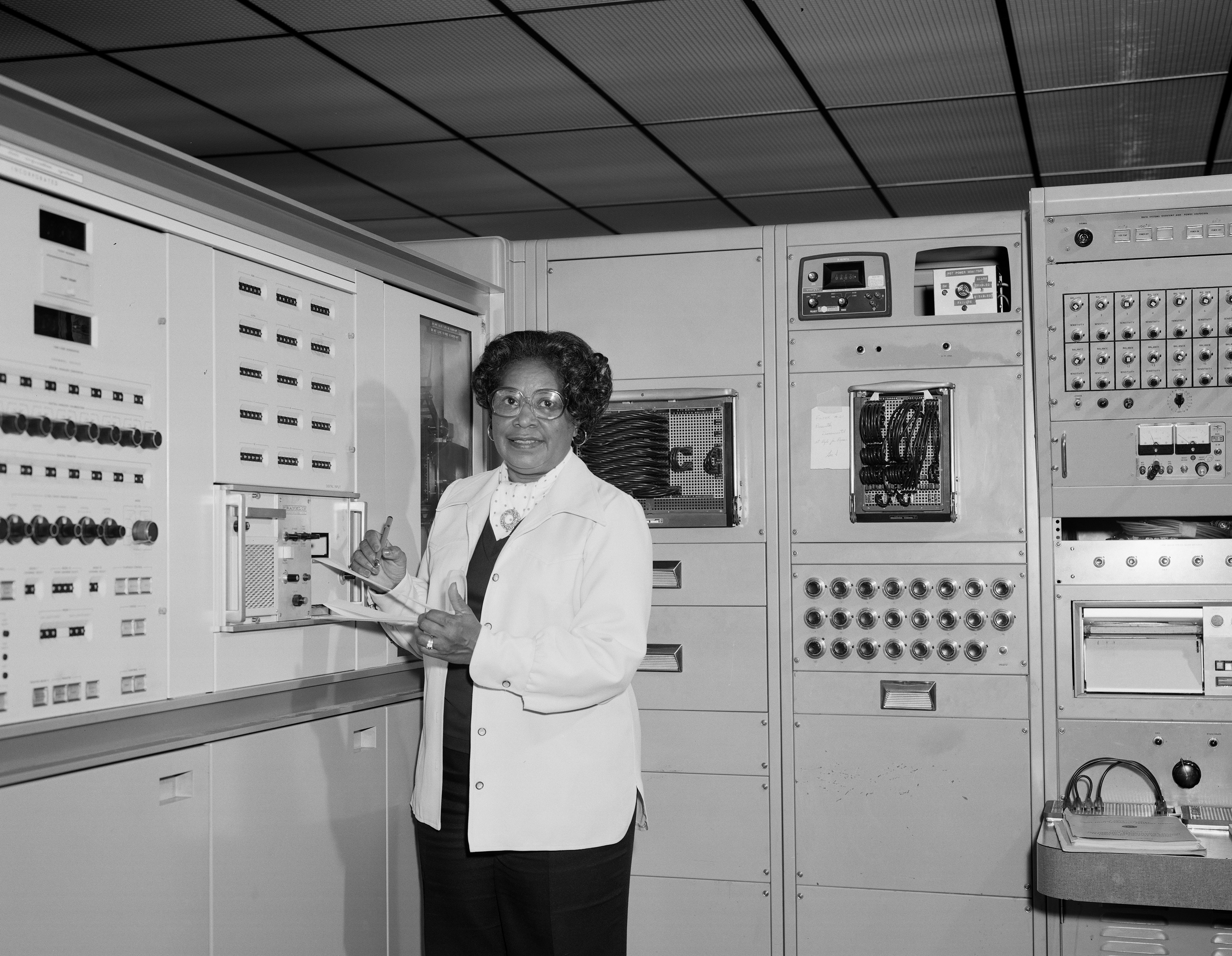
Early life
Mary Winston Jackson was born on 9 April 1921 in Hampton, Virginia. She graduated from Hampton Institute in 1942 with a dual degree in mathematics and physical sciences.
Before joining the space program she worked a string of jobs. NASA's biography lists teaching mathematics at a Black school in Calvert County, Maryland, working as a receptionist at Hampton's King Street USO club, bookkeeping for Hampton Institute's health department, and working as an Army secretary at Fort Monroe. She also spent time at home after the birth of her son, Levi.
From computer to engineer
In April 1951 Jackson joined the West Area Computing section of the Langley Memorial Aeronautical Laboratory, run by the National Advisory Committee for Aeronautics (NACA), NASA's predecessor. This was a segregated unit of Black women mathematicians, and her supervisor was Dorothy Vaughan.
About two years later, engineer Kazimierz Czarnecki invited her to work with his team on the 4-foot by 4-foot Supersonic Pressure Tunnel, and he encouraged her to train as an engineer. The graduate-level mathematics and physics courses she needed were run by the University of Virginia and held at Hampton High School, which was then segregated. She needed special permission from the City of Hampton to attend. The National Park Service notes that a judge at Hampton City Hall approved her enrollment.
She finished the courses, and in 1958, the year NACA became NASA, she became the agency's first Black female engineer. That year she co-authored her first report with Czarnecki, on how nose angle and Mach number affect airflow transition on cones at supersonic speeds. Her research centered on the boundary layer of air around aircraft, and she wrote or co-wrote about a dozen reports.
Advocacy
In 1979 Jackson left engineering, taking a demotion to become Langley's Federal Women's Program Manager. In that role she worked to influence the hiring and promotion of the next generation of women mathematicians, engineers and scientists at NASA. She retired from NASA in 1985.
Outside work she was active in her community. In the 1970s she helped young people at Hampton's King Street Community Center science club build and use a small wind tunnel. She led a Girl Scout troop for more than three decades and was named Langley's Volunteer of the Year in 1976.
Legacy
Jackson died on 11 February 2005. Her story reached a wide audience through the film Hidden Figures, in which Janelle Monáe played her. In 2019 Congress posthumously awarded her the Congressional Gold Medal, together with Katherine Johnson, Dorothy Vaughan, Christine Darden and other women who worked as computers, mathematicians and engineers at NACA and NASA. In June 2020 NASA announced that its Washington, D.C., headquarters would be named in her honor.
Achievements
- 1942: Graduated from Hampton Institute in mathematics and physical sciences
- 1951: Joined the West Area Computing section at Langley under Dorothy Vaughan
- 1958: Became NASA's first Black female engineer and co-authored her first report
- 1979: Became Langley's Federal Women's Program Manager
- 1985: Retired from NASA
- 2019: Posthumously awarded the Congressional Gold Medal
- 2020: NASA headquarters in Washington, D.C., named in her honor
Related entries
Sources
- NASA, "Mary W. Jackson Biography" (Primary source)
- National Park Service, "Places of Hidden Figures: Black Women Mathematicians in Aeronautics and the Space Race" (Primary source)
- Smithsonian National Air and Space Museum, "Hidden Figures" (Reference)
- U.S. House Committee on Science, Space, and Technology, "Chairwoman Johnson Applauds Renaming NASA Headquarters After First African American Female Engineer Mary W. Jackson" (25 June 2020) (Primary source)
Suggest a correction: opens once the database is connected.