Esoteric Studies: this section explores ideas outside mainstream scholarship. Each claim is labeled so you can judge it for yourself.
Esoteric Studies · The Anunnaki and Africa
Councils of gods: Anunnaki, Neteru and Orisha
The claim
The Anunnaki, the Kemetic Ennead and the Yoruba Orisha are versions of one ancient idea.
Mesopotamia, Kemet and Yorubaland each pictured a council of divine powers that came from above to order the world. Scholars see a shared human pattern, not a shared origin. This page is offered as reflection.
What the evidence shows
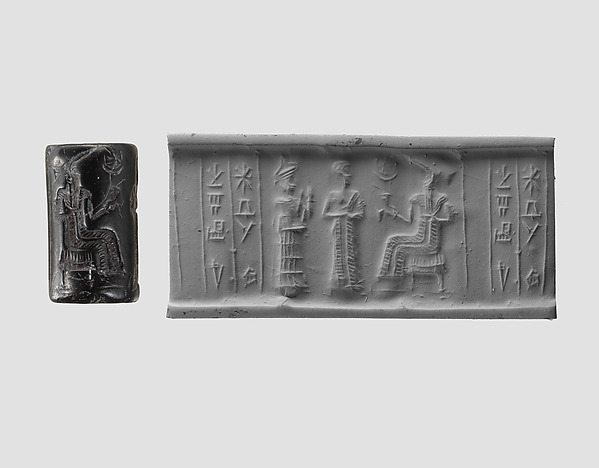
Mesopotamia. The Anunnaki were the great gods as a group, an assembly whose chief task was to decide fates (Brisch, Oracc).
Kemet. At Iunu (Heliopolis), Egyptians honored the Ennead, a family of nine Neteru: Atum the creator; his children Shu (air) and Tefnut (moisture); their children Geb (earth) and Nut (sky); and their children Ausar (Osiris), Auset (Isis), Set and Nebet-Het (Nephthys) (ARCE).
Yorubaland. Yoruba religion honors orisha "too numerous for anyone to name", served through altars, offerings and possession, with Ifá as the system of divination (Duke). In one version of the Ife creation story recorded in 1921, the sons of the high god leave heaven, cross a void above "godless water", and cast down the sand of power so that land appears. Oduduwa is to rule, and Obatala is to shape and enlighten people (Wyndham).
Who says more, and why
Some writers in esoteric and African-centered circles read these councils as memories of the same beings, known by different names. For them, the shared pattern of divine powers descending from above to bring order points to a common source.
What critics say
Councils of gods, creation out of water and gods coming down from above appear in many cultures that never met. Because the pattern is so widespread, a shared structure on its own does not show contact or a common source. No text, artifact or tradition we know of traces the Yoruba orisha or the Kemetic Ennead back to Mesopotamia.
Our assessment: these parallels are real and worth reflecting on. They are not evidence of a shared origin, and this page is labeled as reflection for that reason.
In the encyclopedia
Sources
- Nicole Brisch, "Anunna (Anunnaku, Anunnaki) (a group of gods)", Ancient Mesopotamian Gods and Goddesses, Oracc (Scholarly)
- American Research Center in Egypt, Cairo, glossary: "Ennead" (Reference)
- John Wyndham, "Yoruba Creation Myth", in Myths of Ife (1921), reprinted in Mythology Matters (Colorado Online, Pressbooks) (Primary source)
- Sacred Arts of the Black Atlantic, Duke University, "Yoruba Indigenous" (Scholarly)