Esoteric Studies: this section explores ideas outside mainstream scholarship. Each claim is labeled so you can judge it for yourself.
Esoteric Studies · The Anunnaki and Africa
Early Egypt and Mesopotamia in contact
The claim
Egypt and Mesopotamia, the land of the Anunnaki myths, were in contact before the first pharaohs.
Around 3400 to 3100 BCE, a few Mesopotamian objects and designs reached the Nile Valley. Egyptians chose what to borrow and made it their own.
What the evidence shows
In the late fourth millennium BCE, during the Naqada II and III periods before Egypt was unified, Mesopotamian influence shows up in the Nile Valley in a few clear ways (Joffe, 2000):
- Niched brick walls. Walls built with rows of recesses, known first from temples at Eridu and Uruk in Mesopotamia, appear in Egyptian royal tombs and in the serekh, the palace-facade frame that held the king's name.
- Cylinder seals. A Mesopotamian tool for marking goods. A few appear in Egypt as prestige objects, and Egyptians soon carved their own designs on them.
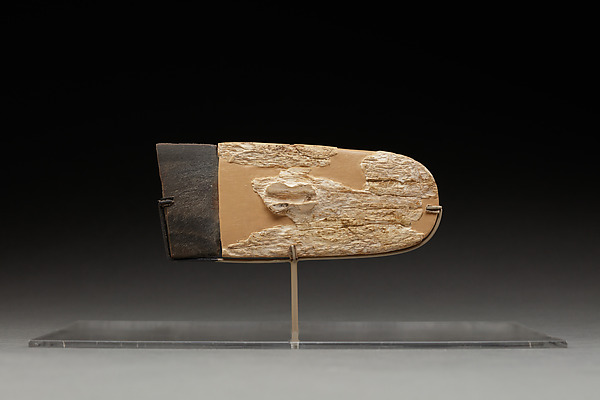
- The "master of animals". A figure standing between two rearing beasts, a Mesopotamian image. It appears on the carved ivory handle of the Gebel el-Arak knife, now in the Louvre, and Egyptian elites later recast it as a protector figure tied to ma'at and kingship.
Joffe dates this contact to two short phases, around 3400 and 3100 BCE, probably by sea through ports in the northern Levant such as Byblos.
Who says more, and why
In the early 20th century, some European scholars used these borrowings to argue that a foreign "dynastic race" from Asia had founded Egyptian civilization. That idea grew out of the racial thinking of the time. Flinders Petrie, the first professor of Egyptology in Britain, was openly preoccupied with sorting ancient Egyptians into racial types (Ashton, 2017).
Some modern esoteric writers turn the same evidence the other way, reading it as a sign that the Anunnaki or their followers taught both civilizations.
What critics say
Archaeologists today reject both readings. Joffe argues the contact was small in scale: a few people bringing back goods and descriptions would have been enough, and Mesopotamia "did not initiate or fundamentally redirect" Egypt's own development. David Wengrow's study of early Egypt treats its rise as a story of social change within north-east Africa, rooted in the Nile Valley's own farming and herding communities. Egypt borrowed a few symbols; it was not founded from outside.
Our assessment: contact between early Egypt and Mesopotamia is documented. It was limited, it ran mostly one way, and Egyptians shaped what they took.
In the encyclopedia
Sources
- Alexander H. Joffe, "Egypt and Syro-Mesopotamia in the 4th Millennium: Implications of the New Chronology", Current Anthropology 41(1), 2000, pp. 113–123 (Scholarly)
- David Wengrow, "The Archaeology of Early Egypt: Social Transformations in North-East Africa, 10,000 to 2650 BC" (Cambridge University Press, 2006), table of contents (Scholarly)
- Sally-Ann Ashton, "Race Theory, Racism and Egyptology", Africa Update 24(1), Central Connecticut State University, 2017 (Scholarly)